Saturday, April 2, 2011

Beautiful Fiesole and Chianti Country

FIESOLE
If you've ever read any of Frances Mayes' books such as "Under The Tuscan Sun", you've heard mention of Fiesole.  It's in the hills surrounding Florence and where the rich go for the summer when the heat in the city gets oppressive.  Well, we wanted to see some greenery and some Roman ruins, so off we went on Thursday by city bus up to Fiesole.  It was a lovely ride up winding roads until we reached the top of the hill.  It took about a half hour and was an incredible ride.  The bus made very few stops and it was obvious that almost everyone on the bus had the same destination in mind.  When we got off the bus we were in the main square of town and right in front of a statue of Victor Emmanuel and Garibaldi, the two credited with unifying Italy, on horseback.

Next lunch was in order.  There were 3 outdoor restaurants to choose from and we chose the one with plaid tablecloths.  No reason why.....we just liked the tablecloths.  Paid off, too, as lunch was really good as you can see below.
Salads, pizza and pasta dishes seem to be normal fare at almost every trattoria.  Believe it or not, this was a single serving pizza.  We shared both it and the salad.....with ham, of course.

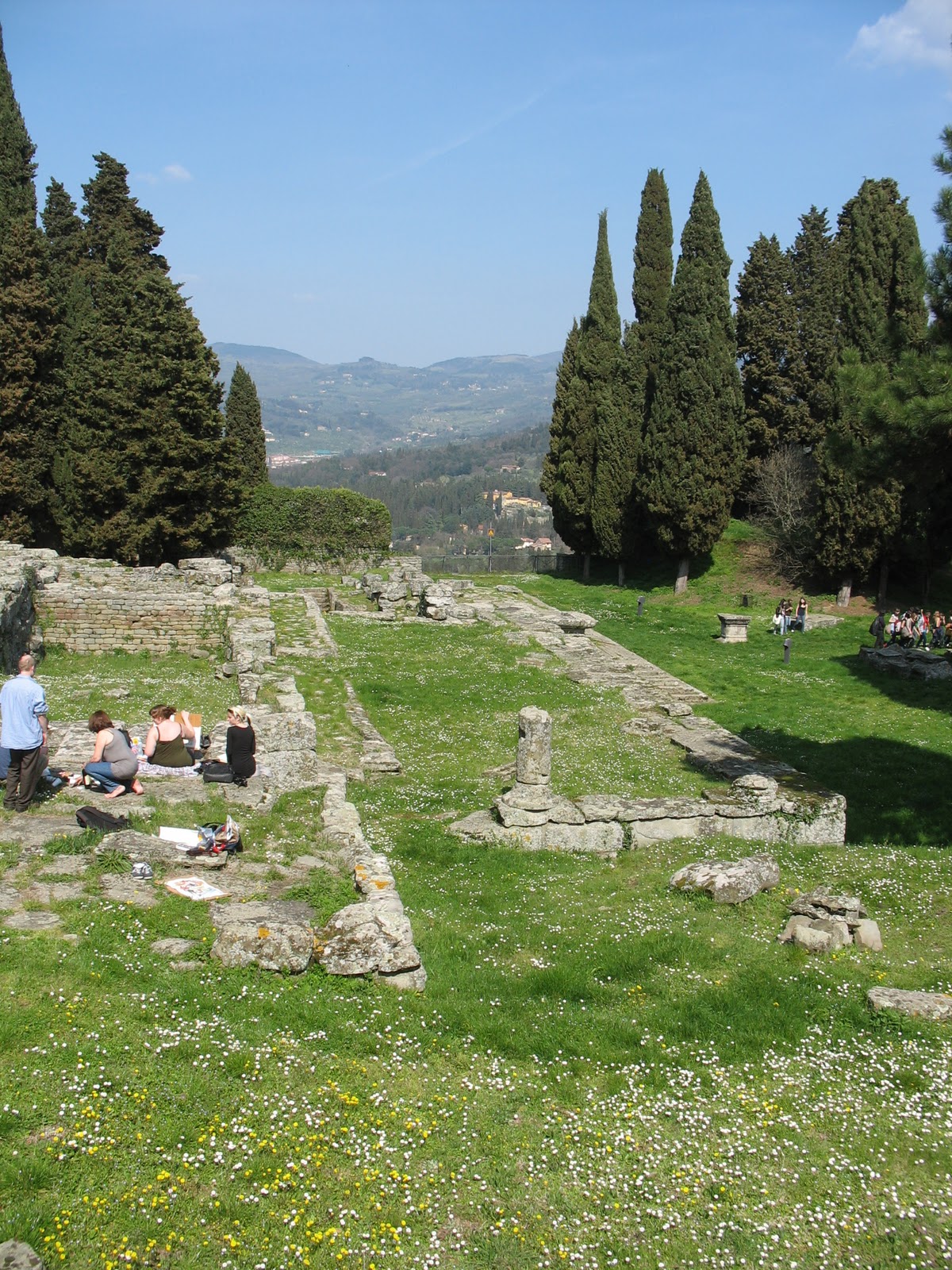
After lunch it was time to venture into the area that housed a museum of Etruscan and Roman ruins and the grounds of the old Roman theater and baths.  The amphitheater used to seat over 3000 people
around  First Century BC.
I sat while Ken looked over the whole area.  Too many steps for my bum knee, but I got to see plenty.

The views from north (towards the mountains) there were pretty fanastic.

Unfortunately, the views back over Florence were quite hazy, so they don't do justice to what's to be seen.


In addition to the theater, the Romans had built what seemed to me to be a pretty sophisticated bath there - indoor and outdoor swimming pools and hot, warm, and cool soaking pools!

The Romans had built all this over an older Etruscan site, which included a temple, and lots of students out sketching.

Afterwards we went into the museum to see room after room of incredible artifacts from the Etruscans, Romans, Greeks, even Lombards (~AD 600) who had used the area as a burial ground.  One interesting Roman necklace was for men to show that they were fertile.  Apparently with all the lead piping in Rome, this wasn't just boastful trash talk.  A good stud was hard to find!
....and of course proof that we were really there.

A DRIVE THROUGH CHIANTI COUNTRY
As beautiful as Florence is, there are very few trees or greenery in the historic city center.  Most of the vegetation you see is on windowsills.  So on Friday we rented a car, stick shift, of course, and set off with our hearts in our mouths, and Ken bravely at the wheel.  He had done his homework, so he knew what the different signs meant.  Italy has a few driving rules all of their own.  Stop signs, for instance, are mere suggestions.  Maybe stop, maybe no......you decide.  Motorcyclists have no rules other than to see if they can weave at least five times on any given road.  If you don't have at least one hair-raising experience with a motorcycle on any given trip, you must not have been driving.  The street may be one-way as marked.  Then again, maybe only part of it is.  After all, you should be able to figure it out without signs.  Knowing all this Ken decided to rent a Hertz little blue Fiat anyway and off to Chianti country we went.  It was a lovely day in the 70s.  

Navigating the roads was actually less difficult than expected.  We rented a GPS, but it was useless since we didn't know how to program it for destinations we wanted.  However, the roads were quite well marked with the names of towns and routes numbers, so prior route planning with the help of Google and a local map made it quite do-able, with only a few anxious moments at the start.

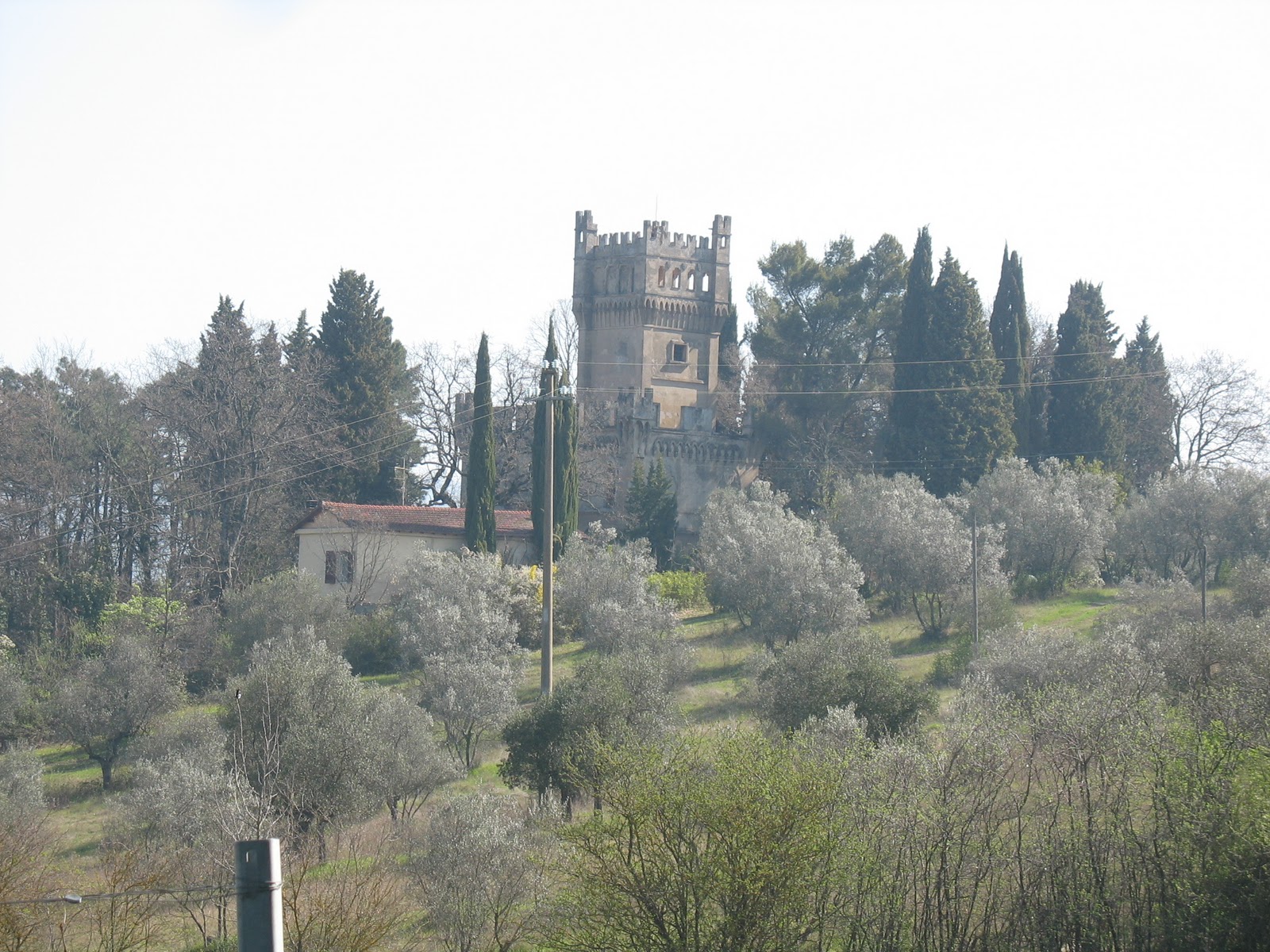
Just one of the castles we passed while traveling up to Greve, a town noted for its Chianti wine. 

Another little scenic sight.  The rows of vegetation could be grape vines.  The other big ticket produce item was olive oil and olive trees were in abundance.  They won't fruit for a few more months, but neither of us have seen an olive tree up close before.  They aren't planted with the same precision as grape vines, but lovely to see with their silvery green leaves. 


Other than wine, the principal claim to fame of Greve is that it was the birthplace of Verranzano, the explorer.  So naturally he gets the place of honor in the town piazza.


We had an interesting lunch in the town square.  While I had a baccala (dry reconstituted salt cod) dish with white beans and tomato sauce, Ken had a wide noodle with wild boar sauce.  Both were quite good. 

Greve, however, was a bit of a disappointment.  The wine tasting required buying a card so that we could pay for our different tastes of Chianti.  Olive oil tasting was free.  Then we tried to go to the COOP, a major grocery chain for stuff like Kleenex and it was closed for lunch.  (Many stores close from 2PM to 4PM daily for lunch)  So we went on to the church in town that was noted in our travel books.  Only problem was it was closed, too, for cleaning.  It had crossed mops at the door.  So we got into our little Fiat and headed towards Castellina.  By the time we got there, their COOP was open and I got the best cut of beef for braciole (thinly sliced beef stuffed with pine nuts, raisins, parsley, lard, garlic and tied into little rolls) cooked in tomato sauce.  I watched the butcher get it as thin as I've ever seen and he didn't use a slicer.  He also gave me some string so that I could tie my little rolls.  Ken decided to explore the town a bit and found it much more to his liking than Greve. 


Castellina was a beautiful walled town on the top of a hill, surrounded by steep hills very reminiscent of Kentucky, or other parts of Appalachia (the resemblance ends there, Chianti region is pretty well off and intensely cultivated for grapes and olives). The historic district was much like Florence's - everything paved, little green and buildings tightly packed.

An interesting feature of the town was that a walkway had been fashioned beneath (or in) the town walls that you could walk along, catch views of the surrounding country out of windows, and even pass stores there.
Entrance to the walkway
The walkway
A view out a window
By this time it was getting late and we had to get our car back by 7 PM.  So we headed off through more stunning countryside to the main, four-lane highway from Siena to Florence, filled up our tank outside Florence (they were going to charge us about 100 euros if we didn't!) and made it back with 15 minutes to spare.

For the musically inclined, I've included this final shot on the ramp-way of the garage where we turned in our car.  That word "adagio" (translated for you in the photo) is a real life Italian word, not just music mumbo-jumbo.
P.S. to the blog on Wednesday about smoking in Italy.  A lot of young people smoke and almost all of them seem to roll their own.  In American whenever I see someone rolling a cigarette I immediately think it's Wacky Tobacci (marijuana).  In Italy it all seems legal tobacco being rolled into a cigarette.

Wednesday, March 30, 2011

The Market & Trash

The Central Market (Mercato Centrale)
Here's a sign on the wall when we enter the Mercato.  In fact this sign can be seen all over Florence, and from what we've been told, is now the law of all of Italy.
Italy has passed a law that states no one may smoke in a public place including restaurants.  We have not seen this law broken much to our pleasure.  The way a lot of restaurants get around the law is to have an outdoor area even in the winter, that is enclosed with plastic when cold and open air when the temperature allows.  Now if you have ever been to Italy, you know that this is a big change.  All of Italy used to be one big chimney of cigarette smoke.  Now you see people on the streets smoking, but no one in buildings lights up.

Now back to shopping at the Mercato Centrale, our favorite place to shop.  If you live in an area that has a major vendors' market like Boston, Cleveland, New York or any other major city in America, then you can understand the makings of the Mercato Centrale.  It is a bunch of vendors indoors in a huge warehouse.  Everyone has a specialty.  There are meats and cheeses, sweets, even just pasta.
Below is one specialty that we hope never to visit, but very popular in Florence.  It's the left-over parts of the animal such as tripe, intestines, all that good stuff......

It's hard for us to believe that this guy makes a living selling this stuff, but he does and it's a good one.
This is even more difficult for us to believe.  Above is a Tripperia and all this guy sells is tripe!  Now that's really specialized.

But there are other places that we do like in the mercato such as


This vendor also sells breads and some candies.  She's a favorite.  Thank goodness there is a lot of walking to be done in Florence or we would have to be rolled back to American.

We also shop at a little grocery store down the street for everyday type stuff.  They have a deli and some produce when we don't get to the supermercato.  Italian cooks very often shop everyday for fresh produce.  But the mercato closes everyday at 2 (14:00 Italian time) except on weekends.  One day we glanced in the frozen section in this little store and saw this box of pizza.  I suspect they think that Americans eat one kind of pizza and this is it.  

But today we did get to the mercato and, while there, bought a couple of sandwiches and decided to go outside on such a beautiful day and eat while sitting on some great big concrete planters that doubled as benches.  As we looked up we were reminded that Italians have come to love their automatic washing machines, but never saw the need for dryers.  

So we ate our sandwiches and listened to the music played by the strolling musicians at the different restaurants until there were too many pigeons eying our food and too many gypsies begging for money.

What Happens to Our Trash?
I'm sure you were wondering this all the time you were reading our blog.  Well, now you'll find out!  (OK, it was a slow day.)   There are all kinds of workers running around Florence (mostly at night) picking up trash and keeping the streets clean.  They do an amazing job, considering the hordes of messy tourists that come through each day.  A lot of businesses just put or leave their trash out on the curb and it magically disappears.  However, Maria Chiara, our landlady, said we were to take our garbage and recycling to some of the many colored bins that are located around the city, every couple of blocks.  The closest to us are at Mercato Centrale and are of three types as shown below: Blue is for cans, glass, and plastic, all together.  As far as I can tell, all kinds of plastic go in.  There isn't any label saying "only #1 or #2" like at home. Yellow is for paper and cardboard.  You can see one man dutifully dumping his in.


Grey bins are for everything else: "Rifiuti non Differenziati", regular trash. 
Also I got a neat photo (at least for garbage lovers) of a small garbage truck filling up a larger truck right in the middle of a busy street.

On Thursday we plan on going to Fiesole outside of Florence with its Roman ruins.  It's also where the rich go in the summer to escape the heat because it's up higher in the hills.

Sunday, March 27, 2011

Capelle Medicee (Medici Chapel)

Last week we went to the Capelle Medicee one afternoon after school.  The spelling puzzles me, since everywhere else it's "Medici" but this may be an archaic spelling that has persisted.  It's attached to the Basilica San Lorenzo, which we described in an earlier post, but has a separate entrance now, so, of course, a separate admission fee can be charged.  It was worth it; it's quite spectacular. Designed by Michelangelo to be the resting place for many of the royal Medici family,  no expense was spared.  Four Michelangelo statues grace some of the sepulchers there.  No photos were allowed, so I only got a few shots (you read right!  Theresa was my lookout and everyone else seemed to feel free to take pictures as the guards looked the other way.), but they indicate the grandeur.  Marble and other beautiful stone (called "pietra dura" here) covered every square inch (or centimeter) in ornate patterns.

The relatively unassuming exterior of the Medici Chapel.

The very impressive interior. They were having a temporary exhibition of paintings done around 1600 in honor of the assassination of  French king Henry IV who was in tight with the Medici's (since he married not one, but two Medici's).
The stunning ceiling, with scenes from the Old and New Testaments
 the in-laid floor which actually got completed in the 1960s
And the Pietra Dura altar panels. This photo doesn't do justice tothem.


As you have probably guessed by now, the Medicis' pretty much ran Firenze for many years.  When the family was downsized to only one woman with no heirs, she left the family fortune and artwork to the city.  I suspect anyone who has ever been here is very grateful to that woman. 

Saturday, March 26, 2011

Festa dell'Annunciazione

March 25 is the Feast of the Annunciation (when the angel Gabriel announces to the Virgin Mary that she's going to give birth to Jesus) and while it's not an important day for Protestants, it's a big deal for Catholic countries.  In fact, for many years it marked the beginning of the new calendar year presumably because of its significance in the life of Jesus.  So it's referred to locally (at least on the tourist info) as "Capodanno" or New Years.  It wasn't until the adoption of the Gregorian calendar, late in England - 1750's - that the day was changed (back, as the Romans had used) to January 1. Of course, with Florence being a Catholic (and tourist) town, this day is a big deal.  Any excuse for a festival!  I went out to see what went on that afternoon.

There was a procession of men and women in Renaissance-type costumes that wound its way from Piazza Repubblica to Piazza della Santissima Annunziata, about 1/4 mile away.  They had:

Flags

Trumpets
Three women, this one with flowers

A dour-looking dude with THE BOOK (I suppose, a Bible) who actually had a very nice smile

And lots of people watching
Despite all the apparent formality it was quite informal.  As they wound through the narrow streets people and acquaintances wandered in and out and chatted with the paraders. 


As they entered the Piazza della S.S Annunziata I got some video that captures the effect pretty well.


The piazza was filled with vendors selling typical festival trinkets.  At least half of the stalls were selling "brigidini", a kind of sweet, licorice-flavored chip that were made on the spot from batter.  The vendor proudly told me they could only be found in Toscano, not in Italy.

brigidini displayed on the wonderful picture created by Luna
When the parade reached the church every one (including the bystanders) filed in and filled an anteroom (cloister) with old frescos on the walls.  Some of the paraders went into the church proper, so I followed, and it was a "Who" concert waiting to happen!  We were all jammed cheek by jowl in the back of the church around a chapel where mass was being celebrated.  The church was quite ornate but dark inside; I didn't get photos since it didnt seem appropriate, but I'm sure you can find some on the net by Googling "Basilica della Santissima Annunziata, Firenze". I didn't stay until the end, but was told that the parade would reassemble and march back to where it started after the mass.

Wednesday, March 23, 2011

A Visit to a Friend in Milan

Last weekend we took a train trip to Milan to visit a friend who, some years ago when she was a senior in high school, spent a year with us as an exchange student.  We have corresponded over the years, visited her and her family, and she invited us to come visit when we were in Italy.

Milan is about 185 miles from Florence by train and on the "Frecciarossa" (Red Arrow) high speed train it took us only 1 hr 45 minutes, for an average speed of about 105 mph, including one stop along the way in Bologna, so the normal cruising speed was even higher.  Most of the first leg through the mountains to Bologna was through tunnels, but the longer second leg was on the flat Po valley.  The train was quite crowded and we couldn't get seats together even though we had reserved them several days in advance.  Still beats driving.  Maybe someday, America...


Laura actually lives in a suburb of Milan near Monza, where the famous auto races take place.  Since most of the buildings are relatively recent, last 25 years or so, it has a distinctly different look to it than central Florence.  There are actually some vacant lots!  She lives in a lovely apartment in a newly developed area with her adorable seven-year-old daughter Luna.  Here Luna is giving us a present of her choosing.....giant coffee cups.  Almost every coffee cup in Italian looks diminutive by American standards.  We now use Luna's cups almost daily.  Above is Ione, Laura's wonderful mother, Laura who looks like she did when she lived with us in 1989, Theresa, who doesn't look like she did in 1989, and Luna.
Mauro, Laura's older brother, also spent the day with us and a wonderful day it was.  Laura and her mother cooked us a typical Milanese meal.  What a treat!  The Bolzonis' also gave Theresa a cookbook with fabulous recipes.  The book is written in Italian but, by the looks of the pictures, we'll be wanting to understand and use it in no time.

They also gave us three CDs of music from the North, South and Middle of Italy.  Mauro assured us that the best is Northern Italian music. 

Laura's father is very ill and has been for 3 years.  It was a special treat to see her mother as Ione cares for her own aging mother and is often at the nursing home where Gianni is.  We loved every minute we spent with our wonderful family in Milano, but missed Gianni Bolzoni's presence. 
Laura and Mauro took us to Monza.  Here we are in front of Monza's Duomo.  There has been a church here since about 600AD, though the current one dates from around 1300-1500.  One of the chapels is supposed to contain one of the nails used at the Crucifixion, and there are some relics from around 600.  It is spectacular both inside and out.  Duomo is another word for cathedral and there are many throughout Italy.  This one had every wall surface painted with the most beautiful artwork. Since there were services going on (Sat evening) we couldn't do photos.

The facade of Monza's Duomo

Maura, Laura and Luna.  Luna absolutely adores her Zio (uncle) Mauro.

Italian homes are, on the average, smaller than American homes and there is a shortage of housing.  Every space is well-planned.  Here is Laura's "shoe rack".  It's next to another one that is closed.  Her apartment had many modular features such as the compact kitchen below.  The long vertical cabinet is actually the refrigerator.  Most of the pieces can be moved if she moves.  The coffee maker on the counter is quite a piece of machinery!


Here's the courtyard at Laura's condo.  Italians love their greenery and window and balcony gardens always make an appearance.

Laura works at Roche Pharmaceuticals as a quality control auditor.   Ken was thrilled to see the row after row of solar panels over the parking lot that help generate electricity for the large plant.  By his count there are about 1000 solar electric panels there, a multi-million euro (or dollar) investment.

One of Luna's favorite dishes......mussels.  We went to a restaurant in Monza...absolutely fabulous!  They were noted for their antipasti bar and their desserts.  You didn't just order one dessert........

You ordered desserts!  The waiter would bring over a selection of at least 5 and a huge dish of candies for children. Notice that our group dug into the chocolate desserts and left the vanilla ones for those less discriminating.   This array of treats also included liqueurs of Italy.  We were one happy (and full!) group when we left.

Thursday, March 17, 2011

Notte Tricolore (Tricolor Night)


This year is the 150th anniversary of the unification of Italy (1861).  It's ironic that their unification happened the same year as the US's dis-unification.  So this year they decided to celebrate Italian Unity Day (its a brand  new holiday).  Now, if you know anything about Italy, it's not really all that unified, so the name "Italian Unity" is pretty much an oxymoron.  The different regions of Italy speak different dialects, particularly in the unindustrialized south, and have had different historical trajectories, so unity is much more nebulous than in the States.  But after much controversy, it was decided to celebrate this year.

One things that has been surprising about Unity Day is the large number of Italian flags that are being displayed.  There's even one hanging from our courtyard.


In past visits to Italy it's been rare to find a flag; Tre tried to buy a little one for Dan some years ago and there were none to be had.

The official day of celebration chosen was today, March 17.  So today there's no school.  Stores were supposed to be closed, too, but most seem to have ignored that.  We're getting a much needed rest today after participating in last night's Notte Tricolore (Night of 3 Colors) festivities.  Most museums were open free in the evening (and so were mobbed) and everybody was out on the streets and piazze to celebrate and listen to music or watch different groups parade by.

After dinner last night we walked down to the Piazza della Signoria, probably the most well-known piazza in Florence, where the Palazzo Vechhio is and the giant statues of Neptune and David and more.
Palazzo Vecchio at night with tricolor lighting (hard to see)
Neptune fountain in P. della Signoria at night
There under the Loggia, amid Roman and Renaissance statues the "Philharmonic Orchestra of Giaocchino Rossini" - actually a concert band by our definition - played music from the Risorgimento, the period of cultural resurgence that accompanied the unification of Italy in the mid 1800's.

Band under the Loggia amid statuary
They were a top-notch band and while the weather wasn't the greatest - chilly and threat of showers - the spirits and the music were great and we listened for quite a while.  Of course, the high point of the concert was Verdi's "Va, Pensiero" from his opera "Nabucco". This is a kind of unofficial national anthem for at least the northern part of Italy.  I recorded a part of it on the movie below.  It was quite stately and moving, and you could hear an undercurrent of people singing to it.


 We asked one man how he knew all the words to the song and did he learn it in school.  He told us that if he loved his homeland, he felt he had to be able to sing "Va, Pensiero".  "I love this land.  I know the song."

There were also marching groups playing jazz, American pop songs, and drums.  One group was dressed in renaissance costumes with a flag twirling contingent.  In Florence we think that as many tights are sold to men as to women thanks to dressing up in medieval dress.

Here's  video of the same group:


We treated ourselves to some gelato and walked back to another musical event, this time indoors and sitting down (thank heavens!).  We entered the Palazzo Bastogi which is along the street next to ours, went up to the "first" floor (European numbering starts one above ground floor) and were ushered into a fabulous salon with an enormous chandelier and painted walls and ceiling. I didn't think photos were appropriate, but you can see a few interiors at:
http://www.consiglio.regione.toscana.it/istituzione/palazzi/Palazzo/bastogi.asp
since it's now the home of the Tuscan Regional Tourist Council.  The second, third, and fourth photos on the site are from this room when music wasn't being played. The music turned out to be quite modern and challenging and again, superbly performed by a group of 7 performers: soprano, violin, cello, clarinet, flute, percussion, and piano.  Something we had never seen before.......the soprano, a lovely young woman, was having to sing a very difficult and dissonant piece nowhere in the key of the musicians.  She held a tuning fork up to her ear before she started each part of her solo.  She often had to sing long stretches unaccompanied and with great emotion which she did extremely well.

There were many other kinds of music at other venues around the city - rock, classical guitar, chorus, swing, and given the proximity to St Patty's Day, Irish.  These went on until all hours (we didn't!) and there were fireworks at 12:30 AM.  It was quite a bash and I'm sure we'll have to be prepared to try to describe our experiences in Italian class tomorrow.  But today we rest.

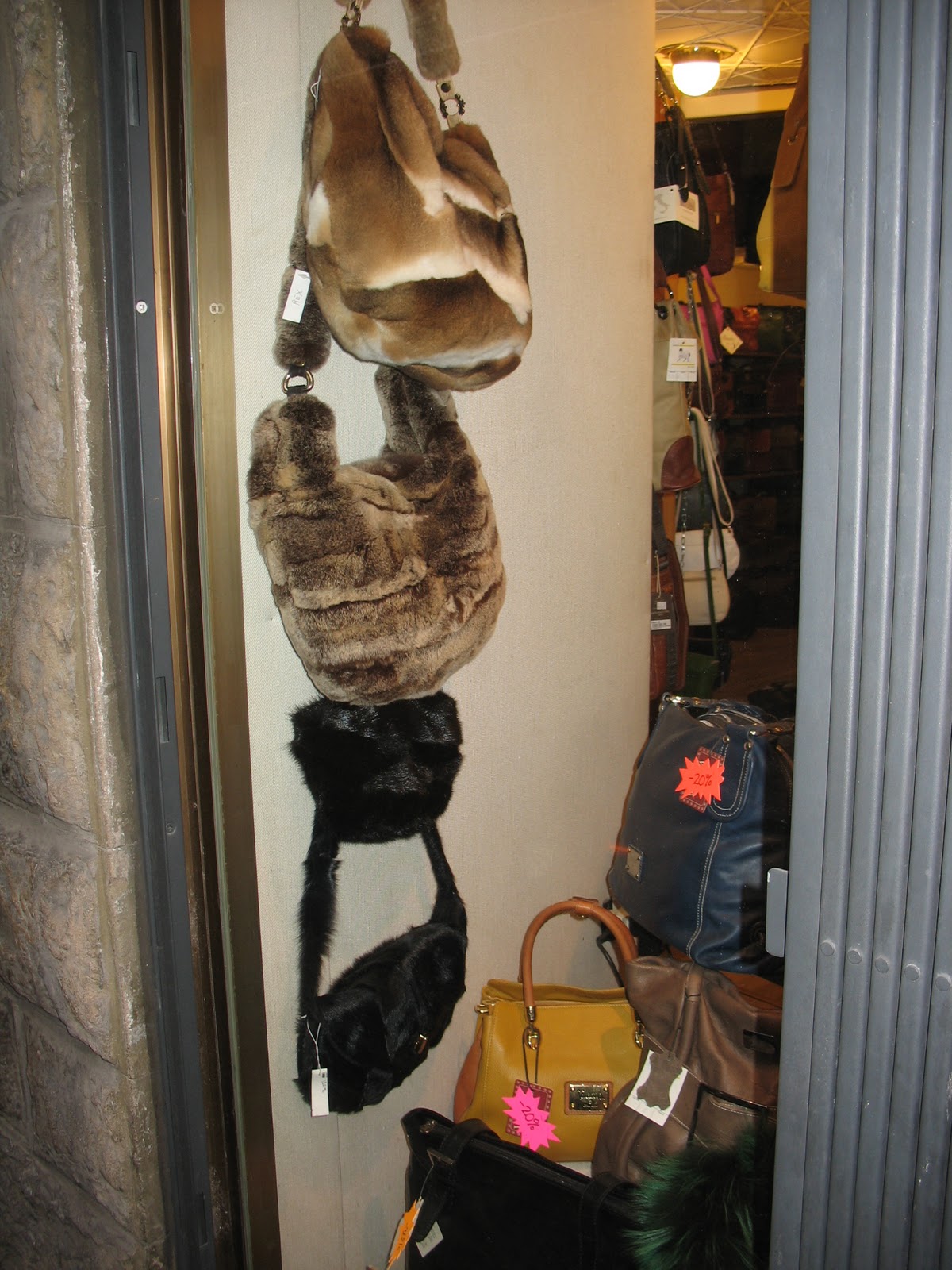
 Not all purses are created equal.  There is a store on our block that has these furry purses in the window and they are truly butt ugly. (Much worse than this picture looks!) All of them look like something that would crawl away if you put it down.  Just goes to prove that even in beautiful Florence there is something that quite doesn't cut it.